Insulated Garage Doors: Energy Efficiency, R-values and More
If you’re dealing with uncomfortable temperature swings in rooms adjacent to your garage, or a garage that is unbearable to use as a workshop or storage space, an insulated garage door might be a cost-effective upgrade. Your garage door is one of the largest openings in your home's thermal envelope. If it's uninsulated, it's acting like a thermal highway, letting heat flood in during summer and drain out during winter.
This guide gives you the complete decision framework. You'll learn how R-values and U-factors work, why third-party Door & Access Systems Manufacturers Association (DASMA) verification matters and what polyurethane versus polystyrene construction means for real-world savings. You'll see honest ROI math by climate zone, payback timelines and a buying checklist that accounts for your specific situation.
Are Insulated Garage Doors Worth It?
Yes, insulated garage doors are worth it for most homeowners, particularly those with attached garages, homes in extreme climates or garages used as living or working space. The value proposition depends on three core factors.

Climate and geography
The temperature differential between outside and inside is the single biggest driver of energy savings from an insulated garage door. The larger and more sustained that gap, the faster the return on investment (ROI).

Garage orientation
Attached and detached garages have different thermal dynamics. An attached garage shares one or more walls with conditioned living space, making those walls vulnerable to heat transfer. Insulation helps stabilize garage temperatures and reduce energy loss to adjacent rooms. A detached storage garage provides fewer energy benefits but still helps protect stored items through more stable temperatures.

Financial payback
Energy modeling studies indicate that homeowners in colder climates can recover their insulation investment within three to five years through reduced heating costs. In milder regions, the payback period may stretch to eight to 12 years, but you gain immediate comfort improvements and noise reduction from day one.
How Much Energy Do Insulated Garage Doors Save?
An insulated garage door doesn't heat or cool your garage directly. Instead, it slows the rate at which outdoor temperatures influence the space.
When your garage temperature stays closer to your home's interior temperature, the heating, ventilation and air conditioning (HVAC) system expends less energy maintaining comfort in rooms that share walls, floors or ceilings with the garage.
Think of it as a buffer zone. An uninsulated door allows your garage to mirror outdoor conditions. Annual savings for an attached garage in a hot-summer, mild-winter climate can reach around $313 per year when upgrading from R-0 to R-18 polyurethane insulation. In extreme climates like Phoenix or Minneapolis, payback happens in under two years. The dollar figures are real and measurable, and they compound annually. As energy costs rise, the savings gap widens in your favor.

Understanding R-value and U-factor
The building and construction industry use both R-value and U-factor to measure thermal performance. These thermal performance ratings are not mathematically associated, as the testing methods are completely different.
R-value
- R-value is the measure of material thermal resistance to heat flow.
- The R-value number is calculated based on the thickness of the insulation and its chemical properties.
- The higher the value the more the material resists heat transfer
Higher is better!
U-factor
- U-factor is a measure of the rate of heat loss through a material.
- The U-factor number is determined based on an actual test of an entire door assembly.
- The lower the value the less heat transfer through a material.
Lower is better!
R-value Recommendation Matrix by Climate Zone
The International Energy Conservation Code assigns U.S. locations to numbered climate zones based on regional heating and cooling demands, with moisture-regime designations such as A, B and C in many zones. Your zone can help you choose an insulation level that delivers meaningful thermal performance:
Mild climates:
These regions experience minimal heating and cooling demands. R-6 to R-9 doors provide adequate thermal resistance without overinvesting in insulation you won't fully utilize.
Moderate climates:
These zones have distinct seasons and moderate heating and cooling loads that justify R-10 to R-13 doors. Midrange insulation offers solid payback timelines and year-round comfort.
Extreme climates:
These areas experience harsh winters and hot summers. R-14 to R-19 doors maximize energy efficiency and comfort in these demanding conditions.
Not sure what zone or climate your home falls into? Our professional dealers operate locally, and can help you pick out the perfect door for your environment.
Why DASMA Verification Matters
Not all R-value claims are created equal, and the difference between a calculated number and a verified measurement can be the difference between real energy savings and marketing hype.
DASMA is the trade association that sets testing and performance standards for the garage door industry in North America. Its Thermal Performance Verification Program is the industry's answer to unverified, self-reported R-value claims. Think of it as a consumer protection tool, not just an industry certification. DASMA partnered with ICC-ES, an internationally recognized testing, inspection and certification body, to administer the TPVP program. All U-factor ratings from participating manufacturers are verified by approved third-party labs.
Look for the TPVP badge or icon, which can only appear with models that participate in the program. Only participating manufacturers have verification program badge in marketing materials. The badge and/or icon denotes legitimate thermal performance rating (validated by third-party testing).

The Truth About R-value Inflation
Some manufacturers advertise R-values based solely on the center point of an insulation panel, ignoring thermal bridging at the edges, gaps around hardware and heat loss through the door's framework.
A door marketed as R-18 may deliver lower whole-door thermal performance in actual use if the manufacturer didn't account for thermal bridging through steel components or air infiltration at panel joints. Third-party verification eliminates this ambiguity by requiring manufacturers to test the entire door assembly, including all structural elements and weather seals that affect thermal performance.
When comparing doors, prioritize whole-door thermal performance ratings over unverified claims. Verified ratings give you reliable performance data you can trust for ROI calculations and climate zone matching.
| Collection | Construction | Insulation Type | U-factor¹ | R-value² |
|---|---|---|---|---|
| Carriage House | ||||
| Classica | CL3000 | Polyurethane | 0.22 | 13.35 |
| Classica | CL2000 | Polystyrene | 0.32 | 6.64 |
| Carriage Court | CC4000 | Polystyrene | 0.26 | 6.48 |
| Designer's Choice | DC3200 | Polyurethane | 0.19* | 19.40* / 13.35** |
| Designer's Choice | DC3138 | Polyurethane | 0.24 | 14.46 |
| Heritage | HR3000 | Polystyrene | 0.26 | 9.05 |
| Heritage | HR2000 | Polystyrene | 0.43 | 6.64 |
| Hillcrest | HI3000 | Polystyrene | 0.23 | 9.05 |
| Hillcrest | HI3138 | Polystyrene | 0.27 | 6.48 |
| Hillcrest | HI2000 | Polystyrene | 0.32 | 6.64 |
| Traditional | ||||
| Olympus | OL3200 | Polyurethane | 0.19† | 19.40† / 13.35‡ |
| Olympus | OL3138 | Polyurethane | 0.24 | 14.46 |
| Heritage | HR3000 | Polystyrene | 0.26 | 9.05 |
| Heritage | HR2000 | Polystyrene | 0.43 | 6.64 |
| Lincoln | LI3000 | Polystyrene | 0.23 | 9.05 |
1 Verified U-factor rating is in accordance with ANSI/DASMA 105.
2 Calculated door section R-value is in accordance with DASMA TDS-163.
* True White Bead Board only.
** All panels and colors except True White Bead Board.
† True White Short and Flush panel designs only.
‡ All panels and colors except True White Short and Flush panel designs.
Insulation Material Science
Two insulation materials dominate the garage door market, and the choice between them affects everything from up-front cost to long-term performance.
Rigid Polystyrene Panels
Polystyrene panels are pre-cut rigid foam boards fitted into the door panel cavities. They're the industry's long-standing, accessible option. In double-layer doors, there is a polystyrene backing instead of steel on the interior. In triple-layer construction, it's sandwiched between two steel skins. This method has been in use for decades and remains a cost-effective choice for moderate climates.
Polystyrene offers clear advantages. It's lower cost, widely available and adequate for mild climates and detached garages. If your garage is detached and used primarily for storage, polystyrene insulation delivers reasonable thermal performance without the premium price tag.
The trade-offs are equally clear. Polystyrene delivers a lower R-value per inch than polyurethane, typically around R-3.8 to R-4 per inch. It's susceptible to separation from the door panel over time if not fully bonded. And it contributes less structural rigidity to the door assembly compared to foamed-in-place alternatives. Polystyrene-insulated residential garage doors commonly fall in the R-6 to R-9 range, depending on model, door thickness and construction.
Foamed-in-Place Polyurethane
Liquid polyurethane is injected into the sealed steel panel and expands to fill every gap, bonding to both the outer and inner steel skins. This creates a single, monolithic composite panel. You're not just putting insulation inside a door. You're creating insulation that becomes part of the door structure.
Polyurethane foam insulation delivers a higher R-value per inch than many common insulation materials, typically around R-6.5. It bonds to steel for superior rigidity and dent resistance. It offers significantly better acoustic performance, dampening vibration and operational noise. And it provides a longer structural lifespan because the foam reinforces the entire panel, not just fills it.
Polyurethane doors cost more up-front. But the ROI calculation from earlier sections often justifies the premium, especially in extreme climates where energy savings compound quickly.
Polyurethane vs. Polystyrene
| Feature | Polystyrene | Polyurethane |
|---|---|---|
| Insulation method | Pre-cut rigid foam panels fitted into cavities | Liquid foam is injected and expanded in place |
| R-value per inch | R-3.8 to R-4 | R-6.5 |
| Typical door R-value range | R-6 to R-9 | R-13 to R-19+ |
| Bond to steel skins | No (panels sit inside, not bonded) | Yes (complete adhesion) |
| Structural rigidity contribution | Minimal | High |
| Sound dampening | Moderate | Superior |
| Typical construction layer | Double or triple | Triple |
| Relative cost | Lower | Higher |
Door Construction Types
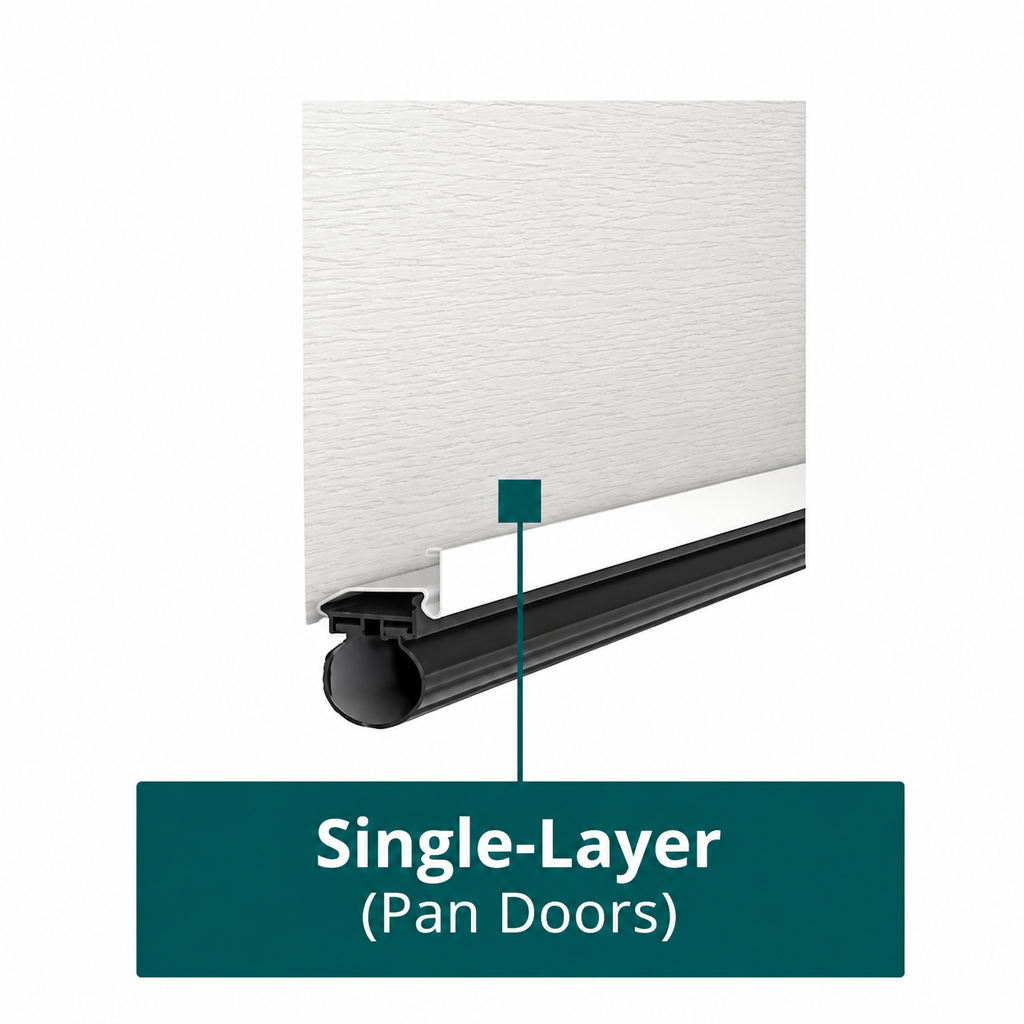
Single-layer doors consist of a single sheet of steel with no insulation or backing material. These doors are the most affordable option but offer zero thermal resistance. Raw steel conducts heat readily, making these doors most suitable for detached garages used exclusively for vehicle or equipment storage.
Single-layer doors are lightweight and easy to operate manually, but they're loud, prone to denting and provide no barrier against outdoor temperatures.
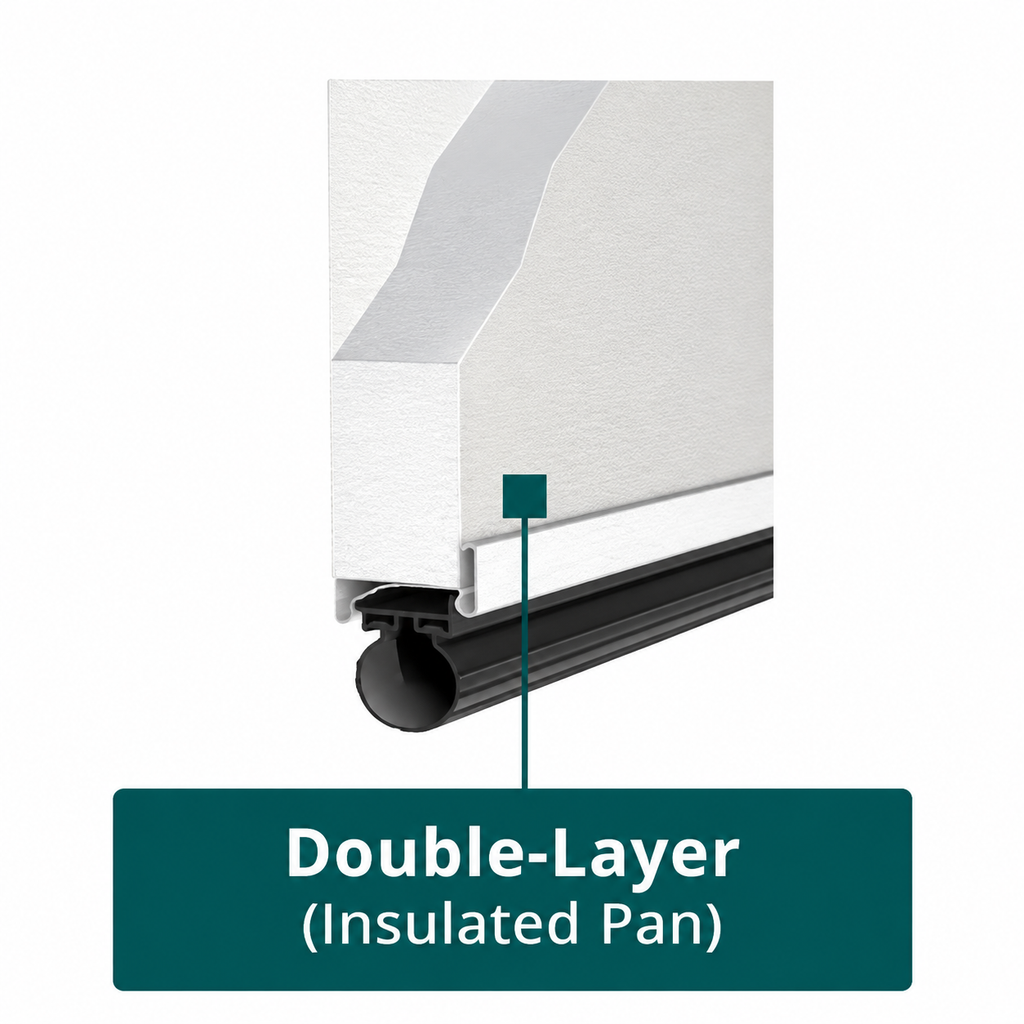
Polystyrene panels are attached to the interior face of the steel. The insulation is visible on the inside. R-values typically land in the R-6 to R-9 range. This is a meaningful upgrade for mild climates or detached garages used for light storage or occasional workshop activity. It is largely insufficient to withstand temperature fluctuations in extreme climates or attached garages adjacent to conditioned space.
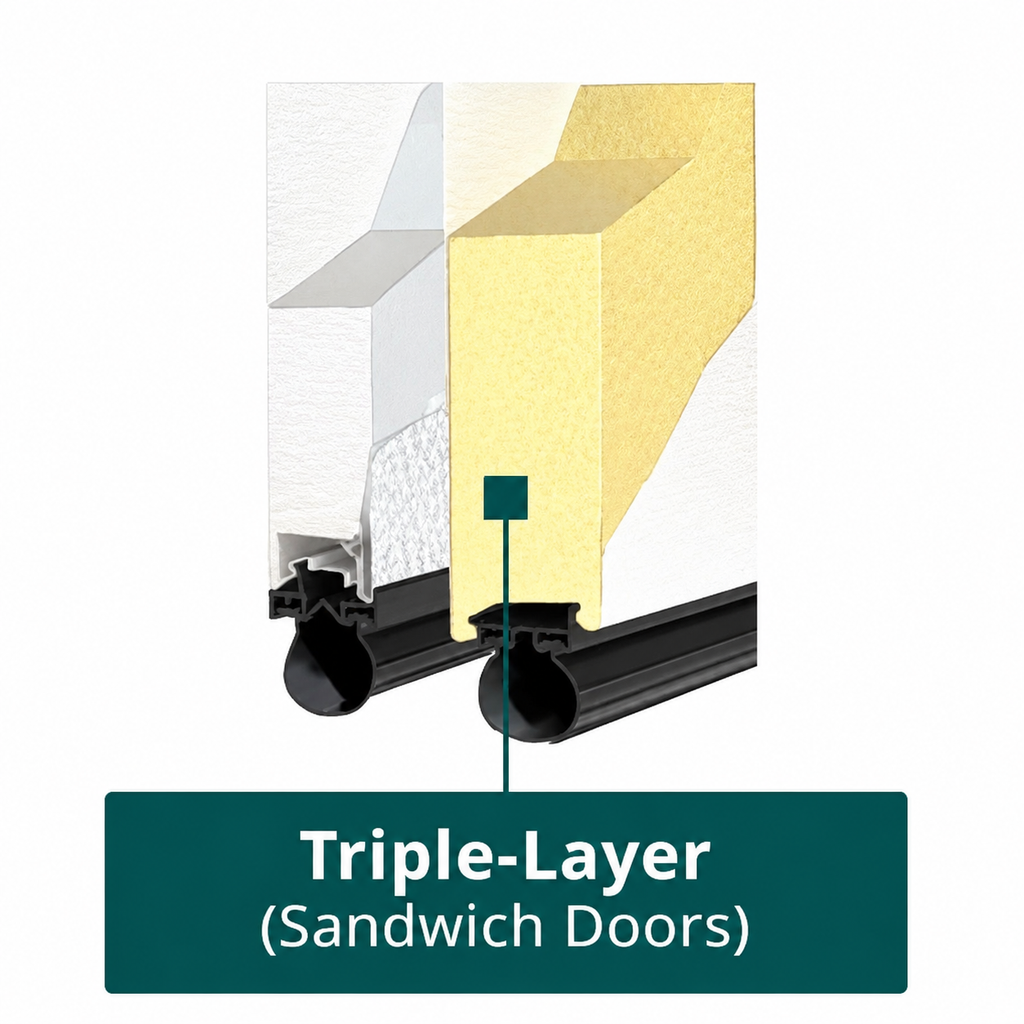
Triple-layer doors sandwich polyurethane or polystyrene insulation between an exterior steel skin and an interior steel backing. This construction offers strong durability, thermal performance and structural support.
The interior steel layer protects the insulation from damage, provides a clean finished appearance and adds rigidity to the entire panel. Triple-layer doors with polyurethane foam insulation offer additional energy efficiency, safety and longevity. They're a strong choice for attached garages, extreme climates and homeowners who want high thermal performance and durability.
Secondary Benefits of an Insulated Door
Energy savings are just the beginning. An insulated garage door delivers practical benefits you'll notice every time you use the space.
The same dense foam core that resists heat also absorbs vibration and sound. For homeowners in suburban neighborhoods, near busy roads or with a garage door adjacent to a bedroom, this is not a minor benefit. The Amarr Quiet Door option reduces door operation noise.
Polyurethane foam-in-place construction transforms a garage door from a flexible steel sheet into a rigid composite panel. This rigidity reduces flexing during operation, which extends the lifespan of rollers, tracks and springs by minimizing stress cycles.
Temperature-moderated garages protect things stored inside. If you store tools, sporting equipment or seasonal items in your garage, insulation prevents the freeze-thaw cycles and extreme heat that degrade these materials over time. For instance, car batteries discharge faster in extreme cold and a warmer garage directly extends battery life, potentially saving you a jump-start call or premature battery replacement.
How to Choose Your Insulated Door
Ask yourself these questions to identify the right door for your situation:
- Is your garage attached to your home? Attached garages share walls, ceilings or floors with conditioned living spaces. These home configurations benefit most from insulated doors because they directly reduce HVAC loads.
- Do you have living space directly above or beside the garage? If your home office, bedroom or family room sits adjacent to the garage, insulation delivers immediate comfort improvements by stabilizing temperatures in the buffer zone.
- What is your local climate zone? Match your climate zone to the R-value recommendations in this guide. Your local weather patterns determine how hard your insulated door will work for you.
- Are you looking to maximize security and dent resistance alongside energy savings? Triple-layer doors with polyurethane foam offer superior structural integrity compared to polystyrene or single-layer alternatives.
- Is the manufacturer's U-factor verified by a certified third party? Only trust values that have been independently tested and certified. Remind yourself to look for the TPVP badge when comparing doors. Not all advertised values are equal, and verified U-factor ratings are the more reliable measurement of whole-door thermal performance.
Find Your Perfect Insulated Garage Door
An insulated garage door is a practical investment in home comfort, long-term energy savings and structural durability. Whether you're replacing a decades-old uninsulated door or building a new home, the right insulated door can deliver long-term value through lower utility bills, quieter operation and a garage space that's more usable year-round.
Amarr has been manufacturing garage doors in the United States since 1951. All of our insulated door models include third-party-verified thermal performance ratings, giving homeowners a clearer picture of whole-door performance beyond advertised specs. Our triple-layer polyurethane doors include options like the Olympus collection, which delivers R-values up to R-19.40 in select configurations. The foamed-in-place construction bonds directly to the steel for superior rigidity, sound dampening and energy efficiency.
Ready to see what's possible? Use our Door Designer tool to explore styles, materials and insulation options tailored to your home's architecture and your climate zone. When you're ready to move forward, find an authorized Amarr dealer near you. They'll provide a site evaluation, precise measurements and professional installation backed by our warranty.
Your garage door should work as hard as the rest of your home. Let's make sure it does.